Ahasuerus and the Scroll of the Torah: A Literary-Theological Note on Esther 1
DOI:
https://doi.org/10.5508/jhs29675Keywords:
Esther, Allusion, Intertextuality, Law of the KingAbstract
The book of Esther, particularly at the very beginning, features distinctive language that implies a contrast between the flamboyant and self-indulgent Ahasuerus, on the one hand, and the ideal Israelite king, on the other. The text draws this contrast by way of multiple allusions to kings who, consistent with the law in Deuteronomy, adhere to the teachings found in “the Scroll of the Torah.” This conclusion supports the view that the Jews, under the rule of Ahasuerus, confront a religious challenge in addition to the existential threat initiated by Haman, and that the transformation achieved by Esther and Mordecai bears an implied theological dimension.
References
Berger, Yitzhak. “Esther and Benjaminite Royalty: A Study in Inner-Biblical Allusion.” JBL 129 (2010): 625–44.
Berger, Yitzhak. Jonah in the Shadows of Eden. ISBL. Bloomington: Indiana University Press, 2016.
Berger, Yitzhak. “Mordechai and Flowing Myrrh: On the Presence of God in the Book of Esther.” Tradition 49.3 (2016): 1–5.
Berger, Yitzhak. “On the ‘Sale’ of the Jews in the Book of Esther.” Forthcoming in Meforash Ba’Sefer: Studies in Bible and Exegesis Presented to Amos Frisch. Edited by Michael Avioz, Jonathan Jacobs, and Itzhak Amar. Ramat Gan, Israel: Bar-Ilan University Press, 2026.
Berlin, Adele. Esther: The Traditional Hebrew Text with the New JPS Translation. JPS Bible Commentary. Philadelphia: Jewish Publication Society, 2001.
Bin-Nun, Yoel. “The Scroll of Reversal” (Hebrew). Pages 47–54 in Hadassah hi Ester: Sefer zikkaron la-Hadassah Esther (Dassi) Rabinovitch z”l: Kovets ma’amarim al Megillat Ester. Edited by Amnon Bazak. Alon Shevut, Israel: Tevunot, 1997.
Bush, Frederic W. Ruth, Esther. WBC 9. Dallas: Word Books, 1996.
Edenburg, Cynthia. Dismembering the Whole: Composition and Purpose of Judges 19–21. AIL 24. Atlanta: SBL, 2016.
Fox, Michael V. Character and Ideology in the Book of Esther. Columbia, S.C.: University of South Carolina Press, 1991.
Gerleman, Gillis. Esther. BKAT 21. Neukirchen-Vluyn: Neukirchener Verlag, 1973.
Gilmour, Rachelle. “Overturning Sovereignty: Esther in Dialogue with the Books of Samuel.” Pages 57–67 in Reading Esther Intertextually. Edited by David G. Firth and Brittany Melton. LHBOTS 725. London: Bloomsbury T & T Clark, 2022.
Grossman, Jonathan. “Dynamic Analogies in the Book of Esther.” VT 59 (2009): 394–414.
Grossman, Jonathan. Esther: The Outer Narrative and Hidden Reading. Siphrut 6. Winona Lake, Ind.: Eisenbrauns, 2011.
Hornung, Gabriel F. Esther Against Joseph’s Backdrop: The Theology and History of an Intertextual Relationship. BZAW 553. Berlin: De Gruyter, 2024.
Japhet, Sara. I & II Chronicles: A Commentary. OTL. Louisville, Ky.: Westminster John Knox, 1993.
Knoppers, Gary N. I Chronicles 10–29: A New Translation with Introduction and Commentary. AB 12a. New York: Doubleday, 2004.
Knoppers, Gary N. “Jehoshaphat’s Judiciary and the Scroll of YHWH’s Torah.” JBL 113 (1994): 59–80.
Knoppers, Gary N. “The Relationship of the Deuteronomistic History to Chronicles: Was the Chronicler a Deuteronomist?” Pages 307–341 in Congress Volume Helsinki 2010. Edited by Martti Nissinen. VTSup 148. Leiden: Brill, 2012.
Koller, Aaron. Esther in Ancient Jewish Thought. New York: Cambridge University Press, 2014.
Levenson, Jon D. Esther: A Commentary. OTL. Louisville, Ky.: Westminster John Knox, 1997.
Lewis, Stephen P. “Narrative Analogy and the Theological Message of Esther: Israel’s Conflicted Relationship with an Angry Sovereign.” Ph.D. diss., Westminster Theological Seminary, 2018.
Lindo, Ron Jr. Literary Allusions in Esther: A Study on the Convergence of Intertexts and Narrative. Studies in Biblical Literature 181. Lausanne: Peter Lang, 2023.
Macchi, Jean Daniel. Esther. IECOT. Stuttgart: Kolhammer, 2018.
Paton, Lewis Bayles. A Critical and Exegetical Commentary on the Book of Esther. ICC. Edinburgh: T & T Clark, 1908.
Silber, David with Ben-Zion Ovadia. For Such a Time as This: Biblical Reflections in the Book of Esther (Hebrew). Jerusalem: Maggid, 2017.
Simon, Moshe David. “ ‘Many Thoughts in the Heart of Man ...’: Irony and Theology in the Book of Esther.” Tradition 31.4 (1997): 5–27.
Smith, Cooper. “Inner-Biblical Allusion and the Direction of Dependence: Toward a Comprehensive List of Criteria.” JHS 22 (2022): 1–26. Online: https://jhsonline.org/index.php/jhs/article/view/29632/21634.
Thambyrajah, Jonathan A. “ ‘Exodus’ in Diaspora and the Homeland: Narrative Technique and a Model for Salvation in Ezra-Nehemiah and Esther.” JHS 23 (2023): 1–21. Online: https://jhsonline.org/index.php/jhs/article/view/29611/21638.
Tiňo, Jozef. King and Temple in Chronicles: A Contextual Approach to Their Relations. FRLANT 234. Göttingen: Vandenhoeck & Ruprecht, 2010.
Winitzer, Abraham. “The Reversal of Fortune Theme in Esther: Israelite Historiography in Its Ancient Near Eastern Context.” JANER 11 (2011): 170–218.
Downloads
Published
How to Cite
Issue
Section
License
Copyright (c) 2026 Yitzhak Berger

This work is licensed under a Creative Commons Attribution 4.0 International License.
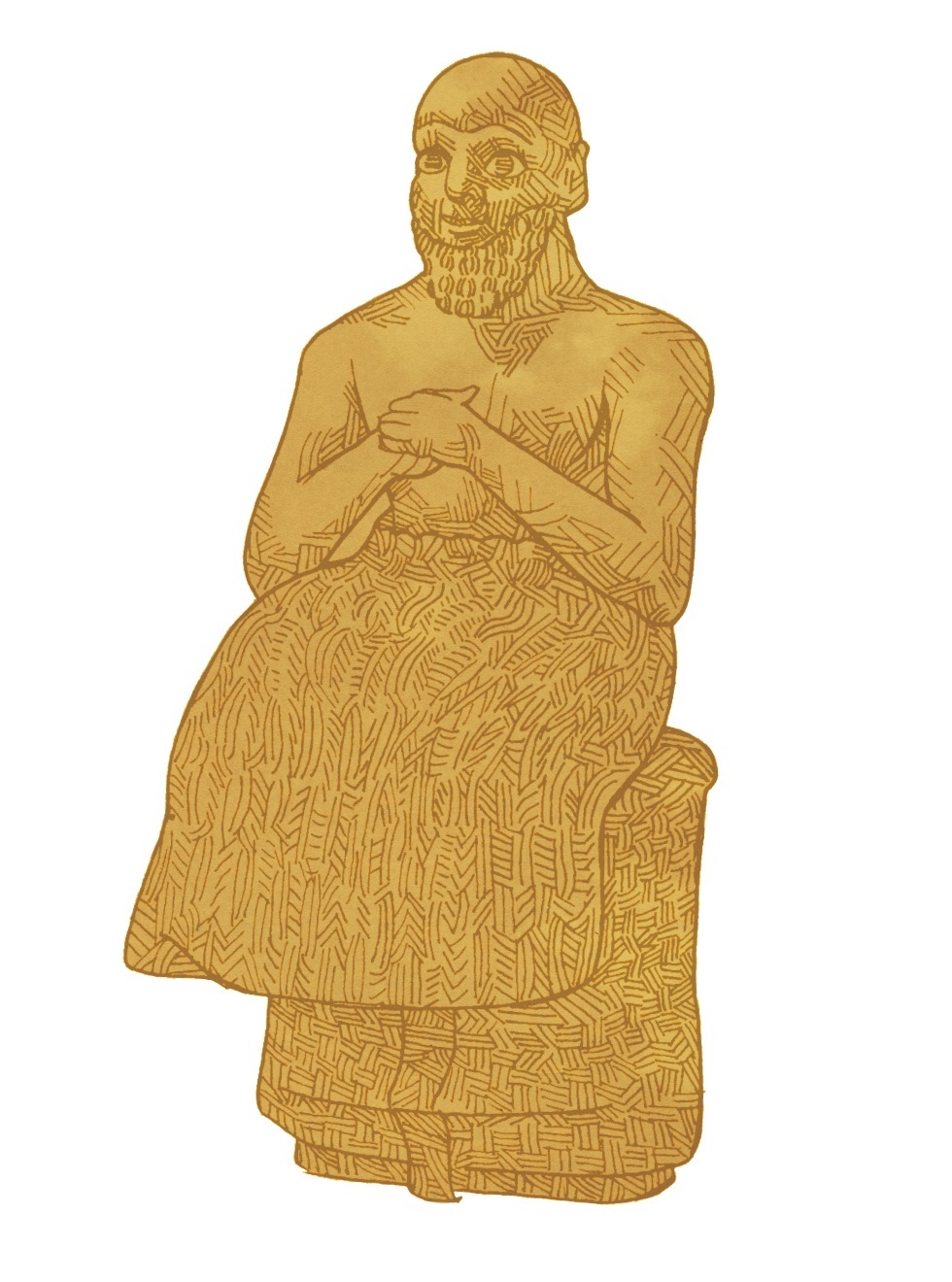 Statue of Ebih-Il, drawing by Simeon Goa, © Journal of Hebrew Scriptures