Truth and Writing in Daniel: Memories of Persian Media
Ancient Jewish Memories of Achaemenid Persia 1
DOI:
https://doi.org/10.5508/jhs29770Keywords:
Persia, Babylon, Darius, Cyrus, Daniel, writing, truthAbstract
This essay explores how the book of Daniel articulates a contrast between Babylonian and Persian media. While Daniel 1–5 imagines Babylonian power as linked to monumentality, Daniel 9–12, set in the reigns of Darius and Cyrus, emphasizes circulatable writing as crucial to order and truth. This contrast is mobilized by the book’s authors to depict the Seleucids as akin to the Neo-Babylonians and in contrast to the Persians. This contrast is achieved via the book’s language of written “truth” (אמת).
References
Austin, Michel. “The Seleukids and Asia.” Pages 121–33 in A Companion to the Hellenistic World. Edited by Andrew Erskine. Malden, MA: Blackwell, 2005.
Boardman, John. Persia and the West: An Archaeological Investigation of the Genesis of Achaemenid Art. London: Thames & Hudson, 2000.
de Bruecker, Geert. “Berossus of Babylon (680)” in Jacoby Online. Brill’s New Jacoby, Part III. Edited by Ian Worthington. Leiden: Brill, 2010.
Carlson Hasler, Laura. Archival Historiography in Jewish Antiquity. New York: Oxford University Press, 2020.
Collins, John J. Daniel: A Commentary on the Book of Daniel. Hermeneia. Minneapolis, MN: Fortress Press, 1994.
Dusinberre, Elspeth R. M. Empire, Authority, and Autonomy in Achaemenid Anatolia. New York: Cambridge University Press, 2013.
Eckhardt, Benedikt. “Achaemenid Religious Policy after the Seleucid Decline: Case Studies in Political Memory and New Eastern Dynastic Representation.” Pages 269–98 in Political Memory in and after the Persian Empire. Edited by Jason M. Silverman and Caroline Waerzeggers. Atlanta: SBL Press, 2013.
Fewell, Danna Nolan. Circle of Sovereignty: A Story of Stories in Daniel 1–6. Sheffield, England: Almond Press, 1988.
Fitzpatrick-McKinley, Anne. Empire, Power, and Indigenous Elites. Leiden: Brill, 2015.
Garrison, Mark B. “Royal Achaemenid Iconography.” Pages 566–95 in The Oxford Handbook of Ancient Iran. Edited by D.T. Potts. New York: Oxford University Press, 2013.
Goldingay, John E. Daniel. WBC 30. Dallas: Word Books, 1989.
Han, Jin Hee. Daniel’s Spiel: Apocalyptic Literacy in the Book of Daniel. Lanham: University Press of America, 2008.
Hartman, Louis F., and Alexander A. Di Lella. The Book of Daniel. AB 23. New York: Doubleday, 1978.
Haubold, Johannes. Greece and Mesopotamia: Dialogues in Literature. Cambridge: Cambridge University Press, 2013.
Howard, Cameron B.R. “Writing Yehud: Textuality under Persian Rule.” PhD diss., Emory University, 2010.
Kirkpatrick, Shane. Competing for Honor: A Social-Scientific Reading of Daniel 1–6. Leiden: Brill, 2021.
Kosmin, Paul J. The Land of Elephant Kings: Space, Territory, and Ideology in the Seleucid Empire. Cambridge, MA: Harvard University Press, 2014.
Kosmin, Paul J. Time and Its Adversaries in the Seleucid Empire. Cambridge, MA: The Belknap Press of Harvard University Press, 2018.
Kosmin, Paul J. “Seeing Double in Seleucid Babylonia: Rereading the Borsippa Cylinder of Antiochus I.” Pages 173–93 in Patterns of the Past. Edited by Alfonso Moreno and Rosalind Thomas. Oxford: Oxford University Press, 2014.
Kratz, Reinhard. “Nabonid in Qumran.” Pages 253–71 in Babylon: Wissenkultur in Orient und Okzident. Edited by Cancik-Kirschbaum, Margarete van Ess, and Joachim Marzahn. Boston: De Gruyter, 2011.
Lincoln, Bruce. ‘Happiness for Mankind’: Achaemenian Religion and the Imperial Project. Acta Iranica. Leuven: Peeters, 2012.
Ma, John. Statues and Cities: Honorific Portraits and Civic Identity in the Hellenistic World. Oxford: Oxford University Press, 2013.
Newsom, Carol A. Daniel: A Commentary. Louisville, KY: Westminster John Knox Press, 2014.
Newsom, Carol A. “Why Nabonidus? Excavating Traditions from Qumran, the Hebrew Bible, and Neo-Babylonian Sources.” Pages 57–79 in The Dead Sea Scrolls. Edited by Sarianna Metso, Hindy Najman, and Eileen Schuller. Leiden: Brill, 2010.
Ogden, Daniel. The Legend of Seleucus: Kingship, Narrative and Mythmaking in the Ancient World. Cambridge: Cambridge University Press, 2017.
Perrin, Andrew B., and Loren T. Stuckenbruck, eds. Four Kingdom Motifs before and Beyond the Book of Daniel. Leiden: Brill, 2021.
Polaski, Donald C. “Mene, Mene, Tekel, Parsin: Writing and Resistance in Daniel 5 and 6.” JBL 123 (2004): 649–69.
Polaski, Donald C. “What Mean These Stones? Inscriptions, Textuality and Power in Persia and Yehud.” Pages 37–48 in Approaching Yehud: New Approaches to the Study of the Persian Period. Edited by Jon L. Berquist. Semeia Studies. Atlanta: SBL Press, 2007.
Portier-Young, Anathea E. Apocalypse against Empire: Theologies of Resistance in Early Judaism. Grand Rapids, MI: Eerdmans, 2011.
Root, Margaret Cool. The King and Kingship in Achaemenid Art: Essays in the Creation of an Iconography of Empire. Acta Iranica 19. Leuven: Peeters, 2021.
Schmitt, Rüdiger. The Bisitun Inscriptions of Darius the Great: Old Persian Text. Corpus Inscriptionum Iranicarum 1. London: School of Oriental and African Studies, 1991.
Sharp, Carolyn J. Irony and Meaning in the Hebrew Bible. Bloomington, IN: Indiana University Press, 2008.
Silverman, Jason M. “Are the Concepts of ‘Torah’ and ‘the Prophets’ Texts or Something Else? Educational, Media, and Elite Contexts from the Persian Empire Onwards.” Pages in Scriptures in the Making: Texts and Their Transmission in Late Second Temple Judaism. Edited by Raimo Hakola, Jessi Orpana, and Paavo Huotari. Leuven: Peeters, 2022.
Silverman, Jason M. Persepolis and Jerusalem: Iranian Influence on the Apocalyptic Hermeneutic. New York: T&T Clark, 2012.
Smith-Christopher, Daniel L. “Prayers and Dreams: Power and Diaspora Identities in the Social Setting of the Daniel Tales.” Pages 266–90 in The Book of Daniel, Volume 1 Composition and Reception. Edited by John J. Collins and Peter W. Flint. Leiden: Brill, 2001.
Stevens, Kathryn. “The Antiochus Cylinder, Babylonian Scholarship and Seleucid Imperial Ideology.” The Journal of Hellenic Studies 134 (2014): 66–88.
Stevens, Kathryn. Between Greece and Babylonia: Hellenistic Intellectual History in Cross-Cultural Perspective. Cambridge: Cambridge University Press, 2019.
Strawn, Brent A. “‘A World under Control’: Isaiah 60 and the Apadana Reliefs from Persepolis.” Pages 85–116 in Approaching Yehud: New Approaches to the Study of the Persian Period. Edited by Jon L. Berquist. Atlanta: SBL Press, 2007.
Taussig, Michael. “Culture of Terror–Space of Death. Roger Casement’s Putumayo Report and the Explanation of Torture.” Comparative Studies in Society and History 26 (1984): 467–97.
Tigchelaar, Eibert. “Changing Truths: אֱמֶת and קֹשֶט as Core Concepts in the Second Temple Period.” Pages 395–415 in Congress Volume Stellenbosch 2016. Edited by Louis C. Jonker, Gideon R. Kotzé, and Christl M. Maier. Leiden: Brill, 2017.
Valeta, Daniel M. Lions and Ovens and Visions: A Satirical Reading of Daniel 1–6. Sheffield: Sheffield Phoenix Press, 2008.
Van De Mieroop, Marc. Before and after Babel: Writing as Resistance in Ancient Near Eastern Empires. New York: Oxford University Press, 2022.
van der Spek, R.J. “Multi-Ethnicity and Ethnic Segregation in Hellenistic Babylon.” Pages 101–115 in Ethnic Constructs in Antiquity: The Role of Power and Tradition. Edited by T. Derks and N. Roymans. Amsterdam Archeological Studies. Amsterdam: Amsterdam University Press, 2009.
Waerzeggers, Caroline. “Babylonian Kingship in the Persian Period: Performance and Reception.” Pages 181–222 in Exile and Return: The Babylonian Context. Edited by Jonathan Stökl and Caroline Waerzeggers. Berlin: De Gruyter, 2015.
Waerzeggers, Caroline. “Facts, Propaganda, or History? Shaping Political Memory in the Nabonidus Chronicle.” Pages 95–124 in Political Memory in and after the Persian Empire. Edited by Jason M. Silverman and Caroline Waerzeggers. Atlanta: SBL Press, 2015.
Waerzeggers, Caroline. “The Prayer of Nabonidus in the Light of Hellenistic Babylonian Literature.” Pages in Jewish Cultural Encounters in the Ancient Mediterranean and Near Eastern World. Edited by Mladen Popović, Myles Schoonover, and Marijn Vandenberghe. Leiden: Brill, 2017.
Waller, Daniel James. “Sympathy for a Gentile King: Nebuchadnezzar, Exile, and Mortality in the Book of Daniel.” Biblical Interpretation 28 (2020): 327–46.
White, Justin J. The Poetics of Visuality: Ekphrasis, Material Agency, and the Visual Imagination of Biblical Antiquity. FAT I. Tübingen: Mohr Siebeck, 2024.
Downloads
Published
How to Cite
Issue
Section
License
Copyright (c) 2026 Laura Carlson Hasler, James Nati

This work is licensed under a Creative Commons Attribution 4.0 International License.
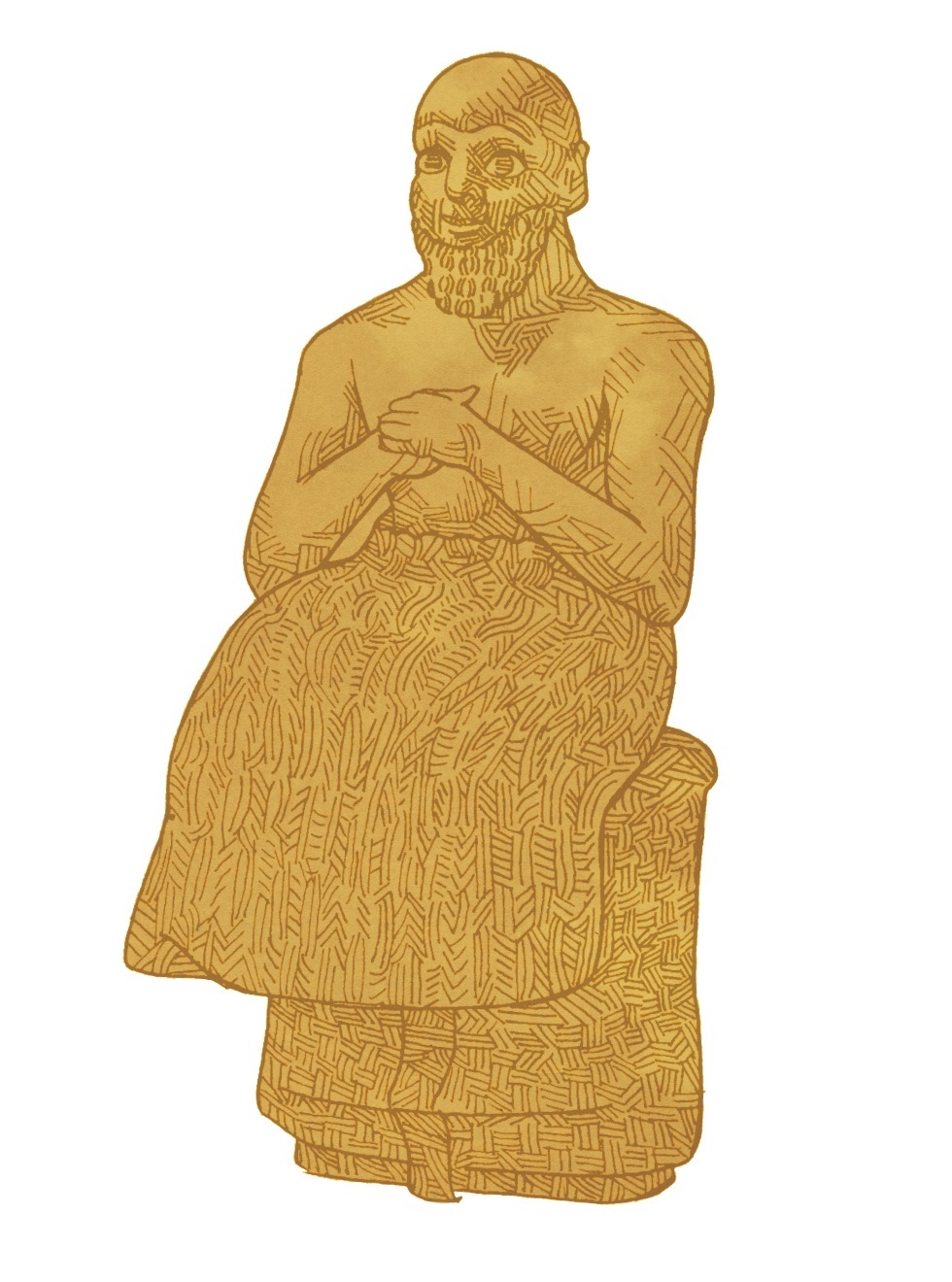 Statue of Ebih-Il, drawing by Simeon Goa, © Journal of Hebrew Scriptures