Imaginations of Persian Power and Kingship in 1 Esdras
Ancient Jewish Memories of Achaemenid Persia 2
DOI:
https://doi.org/10.5508/jhs29771Keywords:
Persian court, 1 Esdras, Achaemenids, Kingship, ZerubbabelAbstract
In this paper, the Story of the Three Bodyguards in 1 Esdras 3–4 is related to Persian royal power and rule as imagined in this Hellenistic-period rewriting. First, the presentation of the court is evaluated regarding Hellenistic and Persian elements. The speeches by the first two bodyguards on wine and the king are then read in the context of the book. All three speeches are shown as reflecting the complexities and ambiguities of imperial power and kingship and Judean positions towards it.
References
Alonso-Núñez, José Miguel. “Die Verfassungsdebatte bei Herodot.” Pages 19–29 in Politische Theorie und Praxis im Altertum. Edited by Wolfgang Schuller. Darmstadt: Wissenschaftliche Buchgesellschaft, 1998.
Barbour, Jennie. “The Eastern King in the Hebrew Bible.” Pages 183–95 in The Romance Between Greece and the East. Edited by Tim Whitmarsh and Stuart Thomson. Cambridge: Cambridge University Press, 2013.
Becking, Bob. “The Story of the Three Youths and the Composition of 1 Esdras.” Pages 61–71 in Was 1 Esdras First? An Investigation into the Priority and Nature of First Esdras. Edited by Lisbeth S. Fried. Atlanta: SBL Press, 2014.
Bird, Michael F. 1 Esdras: Introduction and Commentary on the Greek Text in Codex Vaticanus. Septuagint Commentary Series. Leiden: Brill, 2012.
Böhler, Dieter. “‘Groß ist die Wahrheit und übermächtig!’ (1 Esdr 4,41): Serubbabels Rede über die Wahrheit als philosophische Argumentation und zugleich genuin jüdisches Thema.” ThPh 89 (2014): 29–42.
Böhler, Dieter. 1 Esdras. IEKAT. Stuttgart: Kohlhammer, 2015.
Böhler, Dieter. Die heilige Stadt in Esdras α und Esra-Nehemia: Zwei Konzeptionen der Wiederherstellung Israels. OBO 158. Fribourg: Universitätsverlag; Göttingen: Vandenhoeck & Ruprecht, 1997.
Bringmann, Klaus. “Die Verfassungsdebatte bei Herodot 3,80-82 und Dareios’ Aufstieg zur Königsherrschaft.” Hermes 104 (1976): 266–79.
Brosius, Maria. “Greek Sources on Achaemenid Iran.” Pages 658–68 in The Oxford Handbook of Ancient Iran. Edited by D. T. Potts. Oxford: Oxford University Press, 2013.
Brosius, Maria. “New Out of Old? Court and Court Ceremonies in Achaemenid Persia.” Pages 17–57 in The Court and Court Society in Ancient Monarchies. Edited by Antony Spawforth. Cambridge: Cambridge University Press, 2007.
Carbonaro, Paul. “Les Trois Pages de Darius: Du premier livre d’Esdras (3,1-5,6) aux “Antiquités Juives” (XI,33-67).” RB 119.1 (2012): 20–44.
Dandamayev, Muhammad A. “Courts and Courtiers: I. In the Median and Achaemenid Periods.” Encyclopaedia Iranica 6 (1993): 356–59. Online at https://www.iranicaonline.org/articles/courts-and-courtiers-i.
De Troyer, Kristin. “”A Man Leaves His Own Father …”: On Relationships in 1 Esdras.” BN 164 (2015): 35–50.
De Troyer, Kristin. “Zerubbabel and Ezra: A Revived and Revised Solomon and Josiah? A Survey of Current 1 Esdras Research.” CurBR 1 (2002): 30–60.
De Troyer, Kristin. Die Septuaginta und die Endgestalt des Alten Testaments: Untersuchungen zur Entstehungsgeschichte alttestamentlicher Texte. UTB Theologie, Religion 2599. Göttingen: Vandenhoeck & Ruprecht, 2005.
Donner, Herbert. “Der ‘Freund des Königs’.” ZAW 73 (1961): 269–77.
Eskenazi, Tamara C. “The Chronicler and the Composition of 1 Esdras.” CBQ 48 (1986): 39–61.
Fried, Lisbeth S. “Why the Story of the Three Youths in 1 Esdras?” Pages 83–92 in Was 1 Esdras First? An Investigation into the Priority and Nature of First Esdras. Edited by Lisbeth S. Fried. Atlanta: SBL Press, 2014.
Grabbe, Lester L. “1 Esdras (Greek Ezra).” Pages 107–22 in The Oxford Handbook of the Apocrypha. Edited by Gerbern S. Oegema. Oxford: Oxford University Press, 2021.
Grätz, Sebastian. “The Image of the King(s) in 1 Esdras.” Pages 167–77 in Was 1 Esdras First? An Investigation into the Priority and Nature of First Esdras. Edited by Lisbeth S. Fried. Atlanta: SBL Press, 2014.
Harvey, Paul B. “Darius’ Court and the Guardsmen’s Debate: Hellenistic Greek Elements in 1 Esdras.” In Was 1 Esdras First? An Investigation into the Priority and Nature of First Esdras. Edited by Lisbeth S. Fried. Atlanta: SBL Press, 2014.
Joachimsen, Kristin. “Yehudite Imaginations of King Darius and His Officials: Views from the Province Beyond the River.” Religions 13 (2022): 1–18.
Knoppers, Gary. “Whodunit? The Unlikely Disappearance of Zerubbabel.” Pages 353–91 in Prophets, Priests, and Promises: Essays on the Deuteronomistic History, Chronicles, and Ezra-Nehemiah. Edited by Christl M. Maier and H.G.M. Williamson. VTSup 186. Leiden: Brill, 2021.
Lewis, David M. Greek Slave Systems in Their Eastern Mediterranean Context, c. 800–146 BC. Oxford: Oxford University Press, 2018.
Mathys, Hans-Peter. “Der Achämenidenhof im Alten Testament.” Pages 231–306 in Der Achämenidenhof – The Achaemenid Court: Akten des 2. Internationalen Kolloquiums zum Thema “Vorderasien im Spannungsfeld klassischer und altorientalischer Überlieferungen”, Landgut Castelen bei Basel, 23.-25. Mai 2007. Edited by Bruno Jacobs and Robert Rollinger. Classica et Orientalia 2. Wiesbaden: Harrassowitz, 2010.
Mulder, Martin J. 1 Kings: Volume 1: 1 Kings 1-11. Historical Commentary on the Old Testament. Leuven: Peeters, 1998.
Pohlmann, Karl-Friedrich. Studien zum dritten Esra: Ein Beitrag zur Frage nach dem ursprünglichen Schluß des chronistischen Geschichtswerks. FRLANT 104. Göttingen: Vandenhoeck & Ruprecht, 1970.
Rundgren, Frithiof. “Zur Bedeutung von οἰκογενής in 3. Esra 3,1.” Eranos 55 (1957): 145–52.
Sandoval, Timothy J. “The Strength of Women and Truth: The Tale of the Three Bodyguards and Ezra’s Prayer in First Esdras.” JJS 58 (2007): 211–27.
Schenker, Adrian. “The Relationship Between Ezra-Nehemiah and 1 Esdras.” Pages 45–58 in Was 1 Esdras First? An Investigation into the Priority and Nature of First Esdras. Edited by Lisbeth S. Fried. Atlanta: SBL Press, 2014.
Schmitz, Barbara. “Concepts of Kingship in Aristeas, Xenophon’s Cyropaedia and Isocrates’ Speeches.” Pages 714–29 in Die Septuaginta - Geschichte, Wirkung, Relevanz: 6. Internationale Fachtagung veranstaltet von Septuaginta Deutsch (LXX.D), Wuppertal 21-24. Juli 2016. Edited by Martin Meiser, Michaela Geiger, Siegfried Kreuzer, and Marcus Sigismund. WUNT 405. Tübingen: Mohr Siebeck, 2018.
Schmitz, Barbara. “Wahrheit: Eine Spurensuche von ἀλήθεια in der LXX: Am Beispiel der ’ūrīm und tummīm, der Tobit- und der Pagenerzählung.” Pages 225–38 in Im Angesicht der Anderen: Gespräche zwischen christlicher Theologie und jüdischem Denken. Edited by Florian Bruckmann and René Dausner. Paderborn: Schöningh, 2013.
Talshir, Zipora. “Ezra-Nehemiah and First Esdras: Diagnosis of a Relationship Between Two Recensions.” Bib 81 (2000): 566–73.
Talshir, Zipora. I Esdras: From Origin to Translation. SCS 47. Atlanta: SBL Press, 1999.
Talshir, Zipora. I Esdras: A Text Critical Commentary. SCS 50. Atlanta: SBL Press, 2001.
Torrey, Charles C. Ezra Studies. Chicago: University of Chicago Press, 1910.
van der Kooij, Arie. “On the Ending of 1 Esdras.” Pages 37–49 in VII Congress of the International Organization for Septuagint and Cognate Studies. Edited by Claude E. Cox. SCS 31. Atlanta: SBL Press, 1991.
van der Kooij, Arie. “The Praise of Truth by Zerubbabel and the Issue of Leadership in 1 Esdras.” BN 200 (2024): 9–22.
Wagner, J. Ross. Reading the Sealed Book: Old Greek Isaiah and the Problem of Septuagint Hermeneutics. FAT 88. Tübingen: Mohr Siebeck; Waco, TX: Baylor University Press, 2013.
Wiesehöfer, Josef. “Ctesias, the Achaemenid Court, and the History of the Greek Novel.” Pages 127–41 in The Romance Between Greece and the East. Edited by Tim Whitmarsh and Stuart Thomson. Cambridge: Cambridge University Press, 2013.
Wooden, R. G. “1 Esdras.” Pages 392–404 in A New English Translation of the Septuagint. 2nd ed. Edited by Albert Pietersma and Benjamin Wright. Oxford: Oxford University Press, 2009.
Zahn, Molly M. Genres of Rewriting in Second Temple Judaism: Scribal Composition and Transmission. Cambridge: Cambridge University Press, 2020.
Downloads
Published
How to Cite
Issue
Section
License
Copyright (c) 2026 Maximilian Häberlein

This work is licensed under a Creative Commons Attribution 4.0 International License.
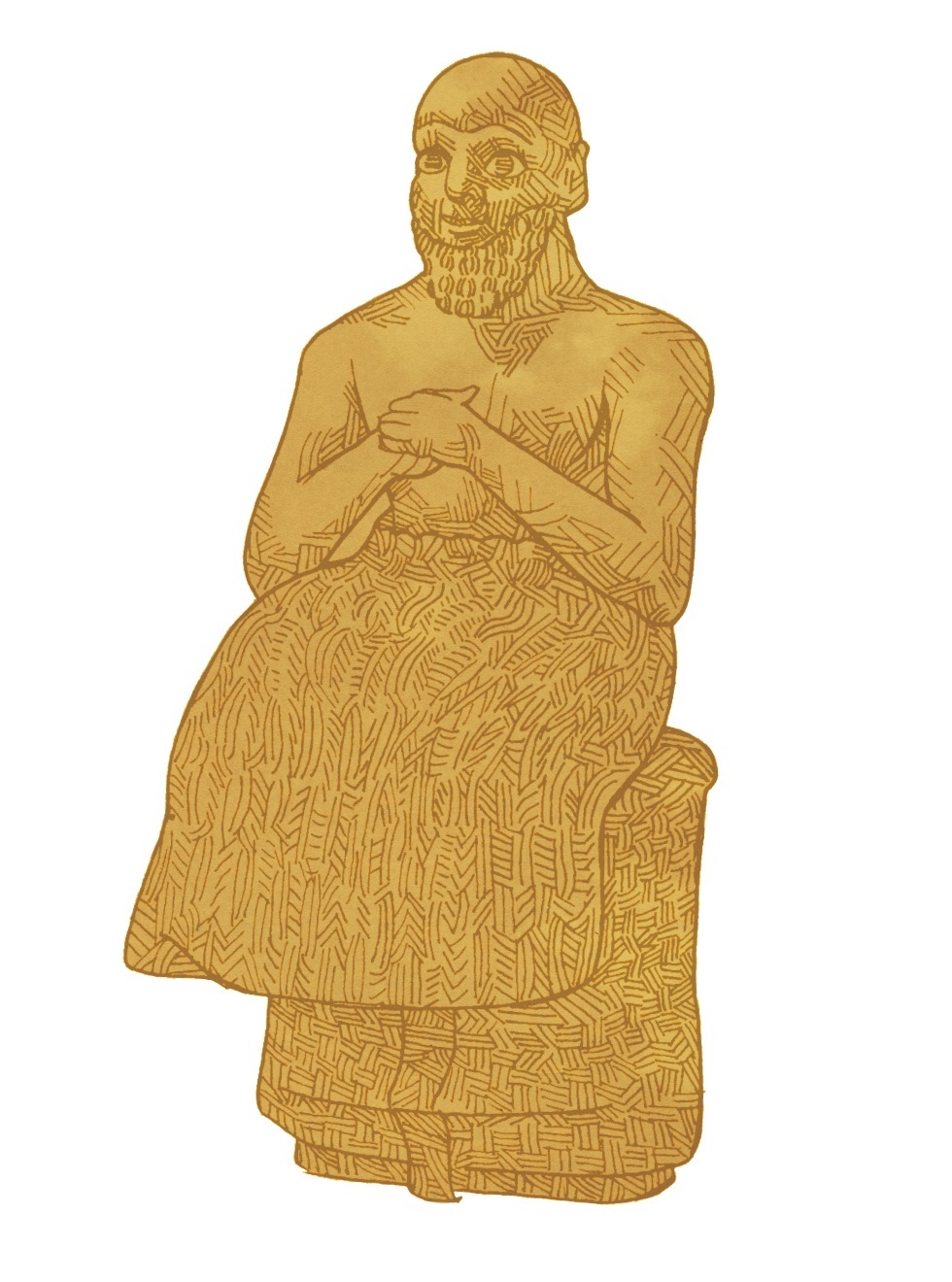 Statue of Ebih-Il, drawing by Simeon Goa, © Journal of Hebrew Scriptures