Esther in Dura Europos
Ancient Jewish Memories of Achaemenid Persia 4
DOI:
https://doi.org/10.5508/jhs29773Keywords:
Dura Europos Synagogue, Art and Architecture, Wall Paintings, Esther, Purim, Reception History, Jewish Diaspora, Jerusalem Temple, Memory, Achaemenid Persia, Roman Era, Visual CultureAbstract
Location matters, and this article explores the depiction and significance of the Esther/Mordecai (Purim) panel's placement next to the Torah niche in the Dura Europos Synagogue. It aims to answer questions such as what the visual representation may have conveyed and which memories the panel might have evoked by its presence in that particular place. To address these questions, the article probes the historical, visual, and ideological context of the panel within the Jewish synagogue in the mid-third century CE. It shows how the local Jewish population engaged with the depiction of Esther and Mordecai, not only as Diaspora heroes, but also as figures linked to Jewish memory, identity, and resistance in a Roman-Persian borderland. In doing so, it showcases how visual media in antiquity served Jewish communities in constructing sacred memory, connecting past and future hopes, and asserting their cultural identity in imperial contexts. In addition, it presents a fresh analysis of the legacy of the by then long-defunct Achaemenid Empire and its enduring presence in the memories, imagination, and minds of Jews living at the crossroads of the Parthian and Roman Empires.
References
Agostini, Domenico. “Eschatology, in Zoroastrianism.” in Encyclopedia of Ancient History. Edited by Daniel T. Potts, et al. Wiley Online Library. https://doi.org/10.1002/9781119399919.eahaa00042.
Baird, Jennifer A. Dura-Europos. London: Bloomsbury Academic, 2018. https://doi.org/10.5040/9781474204194.
Ben Zvi, Ehud. “Asymmetric Hierarchical Systems and Cultural Hegemony among Early Second Temple Literati.” Pages 15–38 in Cultural Hegemony in Second Temple Judaism: Texts, Ideologies, and Struggles for Power. Edited by Danilo Verde and Benedetta Rossi. Leuven: Brepols, 2024.
Ben Zvi, Ehud. Social Memory and the Literati of Yehud. Berlin: de Gruyter, 2019.
Ben Zvi, Ehud. “Who Knew What? The Construction of the Monarchic Past in Chronicles and Implications for the Intellectual Setting of Chronicles.” Pages 349–60 in Judah and the Judeans in the Fourth Century B.C.E. Edited by Oded Lipschits, et al. Winona Lake, IN: Eisenbrauns, 2007.
Burns, Joshua Ezra. “The Special Purim and the Reception of the Book of Esther in the Hellenistic and Early Roman Eras.” JSJ 37 (2006): 1–34.
Cifarelli, Megan, ed. Fashioned Selves: Dress and Identity in Antiquity. Oxford: Oxbow Books, 2019.
Clines, David J. A. “David the Man: The Construction of Masculinity in the Hebrew Bible.” Pages 212–43 in Interested Parties: The Ideology of Writers and Readers of the Hebrew Bible. Sheffield: Sheffield Academic Press, 1995.
Day, John. “Whatever Happened to the Ark of the Covenant?” Pages 250–70 in Temple and Worship in Biblical Israel. Edited by John Day. New York: T &T Clark, 2005.
Ehrlich, Adi. “The Patriarch and the Emperor: The Elephant Mosaic Panel in the Huqoq Synagogue Reconsidered.” Journal of Roman Archaeology 31 (2018): 542–58.
Elsner, Jaś. “Cultural Resistance and the Visual Image: The Case of Dura Europos.” Classical Philology 96 (2001): 269–304.
Fine, Steven. Art and Judaism in the Greco-Roman World: Toward a New Jewish Archaeology. 2nd ed. Cambridge: Cambridge University Press, 2010.
Elsner, Jaś. “Jewish Identity at the Cusp of Empires: The Jews of Dura Europos between Rome and Persia.” Pages 101–21 in Art, History and the Historiography of Judaism in Roman Antiquity. Leiden: Brill, 2014.
Elsner, Jaś. “Jewish Identity at the Limus: The Earliest Reception of the Dura Europos Synagogue Paintings.” Pages 289–306 in Cultural Identity in the Ancient Mediterranean. Edited by Erich S. Gruen. Los Angeles: Getty Research Institute, 2011.
Fine, Steven, ed. “Symposium on the Dura-Europos Synagogue Paintings, in tribute to Dr. Rachel Wischnitzer, November, 1968: The Contributions of Morton Smith and Meyer Schapiro.” Images 3 (2009): 129–41. DOI: 10.1163/187180010X500252.
Flesher, Paul V. M. “Rereadings of the Reredos: David, Orpheus, and Messianism in the Dura Europos Synagogue.” Pages 346–66 in vol. 2 of Ancient Synagogues. Edited by Risto Ilmari Uro and Paul V. M. Flesher. Leiden: Brill, 1995.
Gascou, Jean. “The Diversity of Languages in Dura-Europos.” Pages 75–96 in Edge of Empires: Pagans, Jews, and Christians at Roman Dura-Europos. Edited by Jennifer Y. Chi and Sebastian Heath. New York: Institute for the Study of the Ancient World; Princeton: Princeton University Press, 2011.
Gerleman, Gilles. Esther. Neukirchen-Vluyn: Neukirchener Verlag, 1973.
Goldingay, John, Jill Middlemas, and Adam Silverstein. “The Esther Story/Purim.” Oxford Interfaith Forum, March 17, 2022. https://www.youtube.com/watch?v=Rvg9pdy12Yk.
Gulásci, Zsuzsanna. “Visual Catechism in Third Century Mesopotamia: Reassessing the Pictorial Program of the Dura-Europos Synagogue in Light of Mani’s Book of Pictures.” Journal of Ancient Judaism 9 (2018): 201–29.
Gutmann, Joseph. “The Illustrated Midrash in the Dura Synagogue Paintings: A New Dimension for the Study of Judaism.” Proceedings of the American Academy for Jewish Research 50 (1983): 91–104.
Hachlili, Rachel. “The Dura-Europos Synagogue Wall Paintings: A Question of Origin and Interpretation.” Pages 403–20 in Follow the Wise: Studies in Jewish History and Culture in Honor of Lee I. Levine. Edited by Zeev Weiss, et al. Winona Lake, IN: Eisenbrauns, 2010.
Hachlili, Rachel. “Torah Shrine and Ark in Ancient Synagogues: A Re-evaluation.” ZDPV 116 (2000): 146–83.
Hazan, Olga. “Les femmes salvatrices dans le cycle imagé de la synagogue Doura-Europos.” SR 49 (2020): 193–215.
Herman, Geoffrey. “Ahasuerus, the Former Stable-Master of Belshazzar, and the Wicked Alexander of Macedon: Two Parallels between the Babylonian Talmud and Persian Sources.” AJSRev 29 (2005): 283–97.
Holladay, Carl R. Poets. Vol. 3 of Fragments from Hellenistic Jewish Authors. Atlanta, GA: Scholars Press, 1989.
James, Simon. “Dark Secrets of the Archive: Evidence for ‘Chemical Warfare’ and Martial Convergences in the Siege-Mines of Dura Europos.” Pages 295–317 in Dura Europos: Crossroads of Antiquity. Edited by Lisa R. Brody and Gail L. Hoffman. Chestnut Hill, MA: McMullen Museum of Art, 2011.
James, Simon. “Stratagems, Combat, and ‘Chemical Warfare’ in the Siege Mines of Dura-Europos.” AJA 115 (2011): 69–101.
Jensen, Robin M. “The Dura Europos Synagogue, Early-Christian Art, and Religious Life in Dura Europos.” Pages 173–86 in Jews, Christians and Polytheists in the Ancient Synagogue. Edited by Steven Fine. London: Routledge, 1999.
Kimelman, Reuven. “Again Blessing Formulae and Divine Sovereignty in Rabbinic Liturgy.” Pages 320–75 in The Ancient Synagogue from Its Origins until 200 C.E.: Papers presented at an international conference at Lund University, October 14–17, 2001. Edited by Birger Olsson and Magnus Zetterholm. Stockholm: Almqvist & Wiksell International, 2003.
Kimelman, Reuven. “Blessing Formulae and Divine Sovereignty in Rabbinic Liturgy.” Pages 1–39 in Liturgy in the Life of the Synagogue: Studies in the History of Jewish Prayer. Edited by Ruth Langer and Steven Fine. Winona Lake, IN: Eisenbrauns, 2005.
Koller, Aaron. Esther in Ancient Jewish Thought. Cambridge: Cambridge University Press, 2014.
Kosmin, Paul J. “The Foundation and Early Life of Dura-Europos.” Pages 95–105 in Dura Europos: Crossroads of Antiquity. Edited by Lisa R. Brody and Gail L. Hoffman. Chestnut Hill, MA: McMullen Museum of Art, 2011.
Kraeling, Carl H. The Synagogue: Excavations at Dura-Europos, Final Report VIII, Part 1. New Haven, CT: Yale University Press, 1956.
Laderman, Shulamit. “A New Look at the Second Register of the West Wall in Dura Europos.” Cahiers archéologiques 45 (1997): 5–18.
Magness, Jodi. “Priests and Purity in the Dura-Europos Synagogue.” Pages 421–33 in Follow the Wise. Edited by Zeev Weiss, et al. Winona Lake, IN: Eisenbrauns, 2010.
Mesnil du Buisson, R. Les peintures de la synagogue de Doura-Europos, 245-256 après J.-C. Rome: Pontificio Istituto Biblico, 1939.
Meyers, Eric M. “The Torah Shrine in the Ancient Synagogue: Another Look at the Evidence.” JSQ 4 (1997): 303–38.
Middlemas, Jill. Commentary on the Book of Esther and the Additions. Collegeville, MN: Liturgical Press, forthcoming.
Middlemas, Jill. “Esther in the Eye of the Beholder: Interpretation in Antiquity and Modern Times.” JSOT, forthcoming.
Middlemas, Jill. “The Greek Esthers and the Search for History: Some Preliminary Observations.” Pages 145–63 in Between Evidence and Ideology: Essays on the History of Ancient Israel read at the Joint Meeting of the Society for Old Testament Study and the Oud Testamentisch Werkgezelschap. Edited by Bob Becking and Lester L. Grabbe. Leiden: Brill, 2010.
Middlemas, Jill. “Trito-Isaiah’s Intra-and Internationalization: Identity Markers in the Second Temple Period.” Pages 105–25 in Judah and the Judeans in the Achaemenid Period. Edited by Oded Lipschits, et al. Winona Lake, IN: Eisenbrauns, 2011.
Moon, Warren G. “Nudity and Narrative: Observations on the Frescoes from the Dura Synagogue.” JAAR 60 (1992): 587–658.
Neusner, Jacob. “Judaism at Dura-Europos.” HR 4 (1964): 81–102.
Oates, Joyce M. and Lynne M. Reder. “Memory for Pictures: Sometimes a Picture Is Not Worth a Single Word.” Pages 447–61 in Successful Remembering and Successful Forgetting: A Festschrift in honor of Robert A. Bjork. Edited by Aaron S. Benjamin. New York: Psychology Press, 2011.
Pollard, Nigel. Soldiers, Cities, and Civilians in Roman Syria. Ann Arbor: University of Michigan Press, 2001.
Pollard, Nigel. “Roman Material Culture across Imperial Frontiers? Three Case Studies from Parthian Dura-Europos.” Pages 119–44 in The Greco-Roman East: Politics, Culture, Society. Edited by Stephen Colvin. Cambridge: Cambridge University Press, 2004.
Portuese, Ludovico. “A Gender-Centered Perspective on Manners and Etiquette for Understanding the Historical Role of the Assyrian Queen.” Kaskal 19 (2022): 47–74.
Rajak, Tessa. “The Dura-Europos Synagogue: Images of a Competitive Community.” Pages 141–154 in Dura Europos: Crossroads of Antiquity. Edited by Lisa R. Brody and Gail L. Hoffman. Chestnut Hill, MA: McMullen Museum of Art, 2011.
Römer, Thomas. “The Mysteries of the Ark of the Covenant.” ST 77 (2023): 169–85. https://doi.org/10.1080/0039338X.2023.2167861.
Sabar, Shalom. “The Purim Panel at Dura: A Socio-Historical Interpretation.” Pages 155–63 in From Dura to Sepphoris: Studies in Jewish Art and Society in Antiquity. Edited by Lee I. Levine and Zeev Weiss. Portsmouth, RI: Journal of Roman Archaeology, 2000.
Schenk, Kära L. “The Exodus Narrative and Divine Warfare in the Dura Europos.” Pages 29–48 in Exodus: Border Crossings in Jewish, Christian and Islamic Texts and Images. Edited by Annette Hoffmann. Berlin: de Gruyter, 2020.
Schenk, Kära L. “King David Narratives, Messianic Politics and the Dura-Europos Synagogue.” Pages 300–17 in The Eloquence of Art: Essays in Honour of Henry Maguire. Edited by Andrea Olsen Lam and Rossitza Schroeder. New York: Routledge, 2020.
Schenk, Kära L. “Temple, Community, and Sacred Narrative in the Dura-Europos Synagogue.” AJSRev 34 (2010): 195–229.
Schorch, Stefan. “Rewritten Bible and the Vocalization of the Biblical Text.” Pages 195–214 in Rewritten Bible after Fifty Years: Texts, Terms, or Techniques? A Last Dialogue with Geza Vermes. Edited by József Zsengellér. Leiden: Brill, 2014.
Serra, Eleonora. “Entre art et exégèse: le sacrifice au mont Carmel dans deux panneaux de la synagogue de Doura Europos.” Judaïsme Ancien–Ancient Judaism 9 (2021): 197–230.
Steinberg, Faith. “Women and the Dura-Europos Synagogue Paintings.” Religion and the Arts 10 (2006): 461–96.
Stern, Karen B. “Celebrating the Mundane: Figural Graffiti and Daily Life Among Jews in the Levant.” Pages 237–60 in Jewish Art in Its Late Antique Context. Edited by Uzi Leibner and Catherine Hezser. Tübingen: Mohr Siebeck, 2016.
Stern, Karen B. “Mapping Devotion in Roman Dura Europos: A Reconsideration of the Synagogue Ceiling.” AJA 114 (2010): 473–504.
Stern, Karen B. “Opening Doors to Jewish Life in Syro-Mesopotamian Dura-Europos,” JAA 8 (2018): 178–200.
Tawil, Dalia. “The Purim Panel in Dura in Light of Parthian and Sasanian Art.” JNS 38 (1979): 93–109.
Tawil, Dalia. “The Enthroned King Ahasuerus at Dura in Light of the Iconography of Kingship in Iran.” BASOR 250 (1983): 57–78.
Timuş, Mihaela. “Resurrection, Zoroastrianism.” in The Encyclopedia of Ancient History: Asia, Africa. Edited by Daniel T. Potts, et al. Hoboken, NJ: Wiley Online Library, 2022. https://doi.org/10.1002/9781119399919.eahaa00043.
Visotzky, Burton L. Golden Bells and Pomegranates: Studies in Midrash Leviticus Rabbah. Tübingen: Mohr Siebeck; 2003.
Wharton, Annabel Jane. Refiguring the Post Classical City: Dura Europos, Jerash, Jerusalem and Ravenna. Cambridge: Cambridge University Press, 1995.
Yuval-Hacham, Noa. “Art and Identity in Late Antique Synagogues of the Roman-Byzantine Diaspora.” Arts 8 (2019):164. Doi:10.3390/arts8040164.
Xeravits, Géza G. “Goddesses in the Synagogue?” JSJ 48 (2017): 266–276.
Xeravits, Géza G. “The Message of the West Wall of Dura Europos.” ZDMG 167 (2017): 111–25.
Xeravits, Géza G. “The Reception of the Figure of David in Late Antique Synagogue Art.” Pages 71–90 in Figures who Shape Scriptures, Scriptures that Shape Figures: Essays in Honour of Benjamin G. Wright III. Edited by Géza G. Xeravits and Greg Schmidt Goering. Berlin: de Gruyter, 2018.
Downloads
Published
How to Cite
Issue
Section
License
Copyright (c) 2026 Jill Middlemas, Ehud Ben Zvi

This work is licensed under a Creative Commons Attribution 4.0 International License.
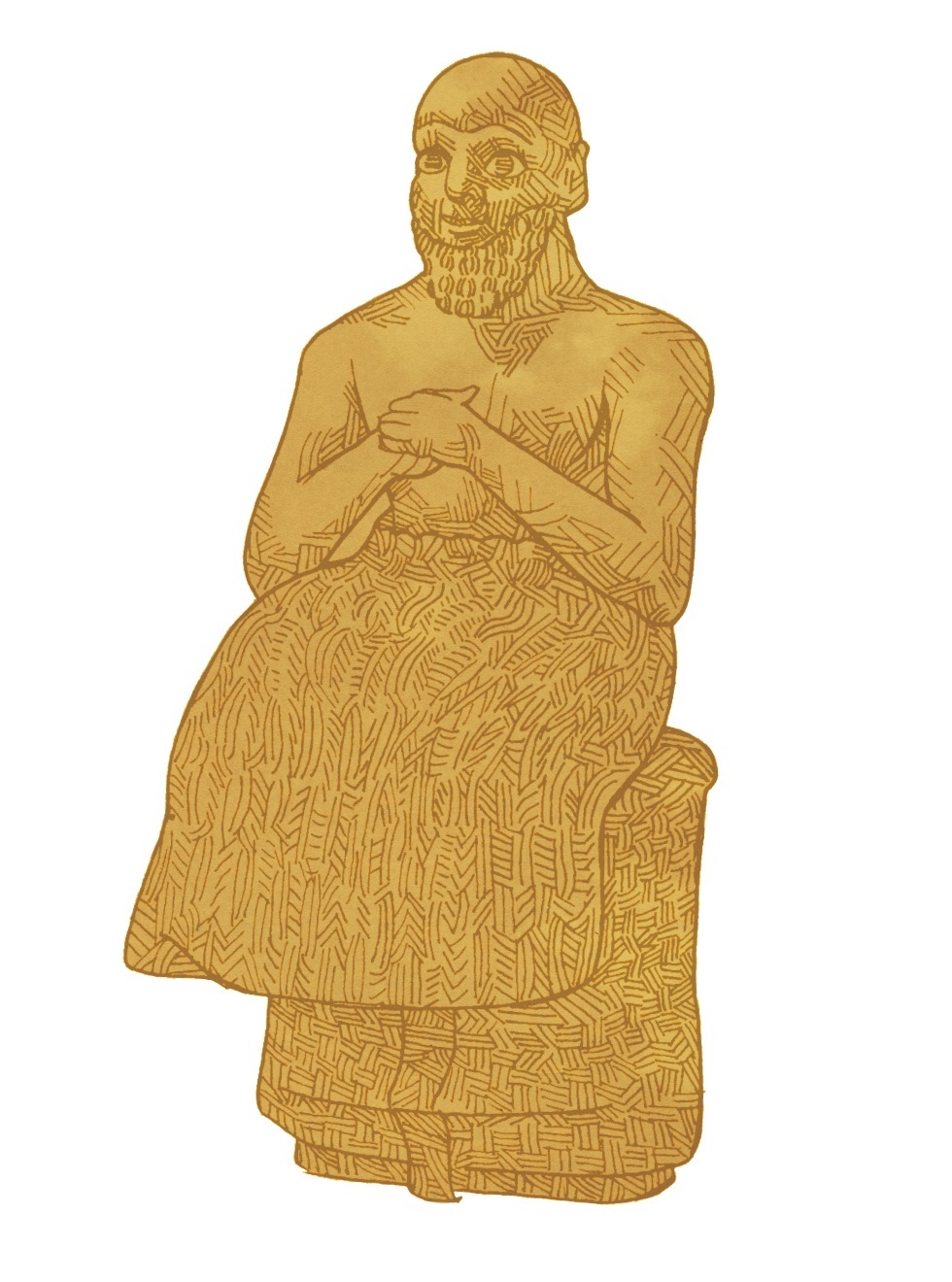 Statue of Ebih-Il, drawing by Simeon Goa, © Journal of Hebrew Scriptures